I recently came across a video in which businessman Robert Herjavec made a point that caught my attention: if you can't sell yourself, you can't sell anything.
It made me think about something I have observed repeatedly in more than 16 years of teaching Movement in Communication.
We spend a great deal of time thinking about what we want to say. We prepare our content, organise our slides, rehearse our words and decide how we want our audience to respond.
But there is another message being communicated at exactly the same time: the one created by our movement.
And surprisingly, the two don't always match.
In fact, after more than 16 years of working with presenters, I would say that I rarely see someone's movement naturally supporting their message all the time.
Perhaps that's why they come to me. 😆
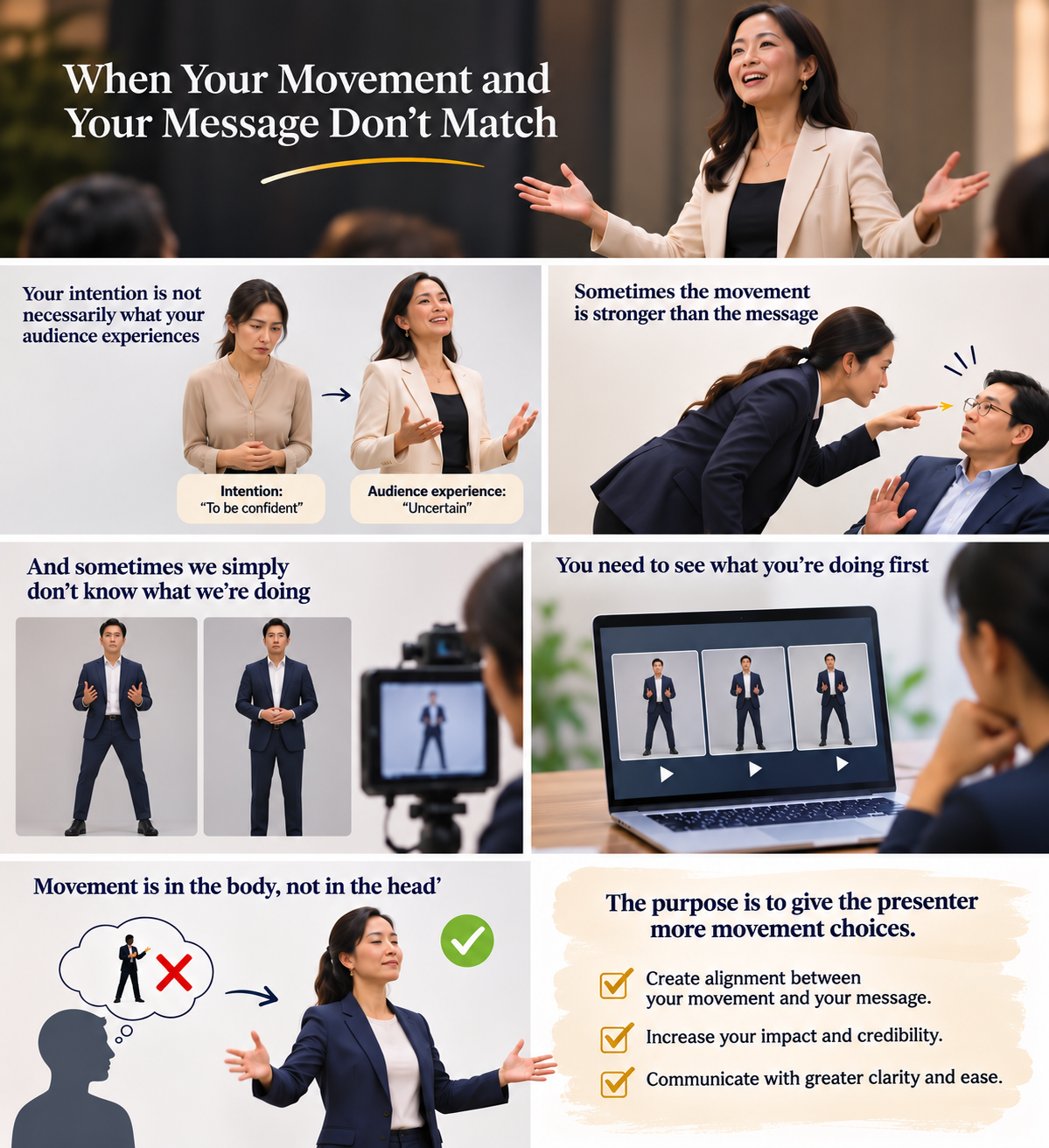
Your intention is not necessarily what your audience experiences
When we present, we know what we intend to communicate.
We may want to appear confident. We may want to persuade someone to support an idea. We may want to engage an audience, establish authority, build a relationship or simply ask someone a question.
But our audience cannot see our intention.
They can only experience what we actually communicate.
This is where movement becomes important.
I often work with presenters who are nervous or anxious. They may be trying very hard to communicate confidence, particularly when they are selling an idea or attempting to persuade an audience.
Yet physically, I may see a great deal of Enclosing—movement that makes the body appear smaller—combined with little or no stance.
Their words may be saying, “I believe in this idea.”
Their movement isn't necessarily supporting that message.
Sometimes the movement is stronger than the message
The opposite can happen too.
Some people naturally use a great deal of Strong Weight in their movement, regardless of what they are trying to communicate.
I once filmed a participant who simply wanted to ask a man sitting in front of her a question.
There was nothing confrontational about the question itself.
Her movement, however, was another matter.
She advanced towards him very quickly while using a strong, direct pointing action. She came so close that she almost poked the poor man in the eye.
Her intention was perfectly innocent. Her movement made the interaction appear considerably more forceful.
Judging by his reaction, I don't think she made a new friend that day. 😆
This is why looking at one gesture in isolation tells us very little. In this case, it was the combination of the quick Advancing, Strong Weight and Direct movement—and the way those elements worked together—that created the experience.
The movement itself wasn't “wrong.”
It simply didn't match what she was trying to do.
And sometimes we simply don't know what we're doing
I've also worked with presenters who maintain an extremely wide stance throughout an entire presentation.
When I show them the recording afterwards and point it out, they are sometimes genuinely surprised.
They had no idea they were standing that way.
There can, of course, be different reasons for the way someone stands or moves. This is why I don't believe in looking at a single physical behaviour and immediately assigning a meaning to it.
What interests me is the wider movement pattern and whether that movement supports what the person is trying to communicate.
This is also why awareness has to come before change.
You need to see what you're doing first
When I work with someone on their movement, it is extremely important that they can see what I see.
Sometimes I don't show them just one recording. I show them two or three.
Why?
Because one video is easy to dismiss.
“I was nervous.”
“I don't normally do that.”
“That was just a bad presentation.”
But when the same movement appears across several recordings, it becomes much easier for the person to recognise that there may be a pattern.
I don't want someone to change their movement simply because I tell them to.
I want them to see it, recognise it and understand it first.
Only then do we begin experimenting with alternatives.
Movement is in the body, not in the head
This is something I tell my participants all the time.
You cannot simply think your way into different movement.
Once someone recognises a movement pattern that isn't supporting their communication, I work with them step by step.
I may give them a scenario and ask them to experiment with more Spreading.
I may ask them to Advance more slowly.
We may work on their stance, the strength of an action or how they physically approach another person.
And occasionally I apparently also need to remind them not to poke their audience in the eye. 🤣
The point isn't to give someone a collection of gestures to perform.
Nor is it to choreograph a presentation so that every sentence has an accompanying movement.
The purpose is to give the presenter more movement choices.
If your habitual response when nervous is to Enclose, what happens when you experience Spreading?
If you tend to Advance quickly and strongly, what happens when you slow the movement down?
If you rarely think about your stance, what changes when you become aware of it?
You begin to discover that there is more than one way your body can support what you want to communicate.
Your movement doesn't need to act out your words
Matching movement to message does not mean physically illustrating everything you say.
If you tell an audience that sales have gone up, you don't need to throw both arms into the air. 😆
The more useful question is:
What am I trying to achieve with this message?
Am I trying to engage?
Persuade?
Reassure?
Challenge?
Establish authority?
Build a relationship?
The movement that supports one intention may not support another.
That is why there is no single “correct” way to move when presenting.
See what your audience sees
Perhaps this is where Robert Herjavec's comment about selling yourself becomes particularly interesting.
Before an audience can respond to your idea, they are experiencing you delivering it.
Your words are part of that experience.
So is your movement.
And when the two support one another, the message may be experienced very differently from when they appear to be pulling in different directions.
The first step isn't learning how you should move.
It is discovering how you already move.
Because you know what you intended to communicate.
Your audience only knows what they experienced.
I really like this one, Alisa. It feels noticeably different from the previous articles while still belonging to the same series. And the humour doesn't feel artificially inserted because the ridiculous story actually happened. 🤣
I particularly like that we haven't turned this into “Enclosing = insecurity” or “wide stance = X.” The article repeatedly brings the reader back to movement in relation to intention, combinations and patterns, which is much closer to your actual work.
And that final line feels very Movement in Communication to me:
You know what you intended to communicate. Your audience only knows what they experienced