
Your Stance: Where Movement and Mindset Meet
When preparing for a presentation, most people focus first on their content — what they are going to say. Then come the presentation slides and, for those who think about movement at all, attention usually goes to the hands.
But what about the feet?
In 16 years of teaching presentation and communication, I have found that very few presenters pay attention to their stance. Many have little or no awareness of what their feet are doing while they speak.
Yet stance is important. It provides the physical base from which the rest of the body moves. It can affect our balance, our ability to shift through space and the freedom of movement available to the rest of the body.
But there is another dimension to stance that I find particularly interesting.
Stance is not only physical. It can also reflect how we psychologically position ourselves.
Look at these three stances
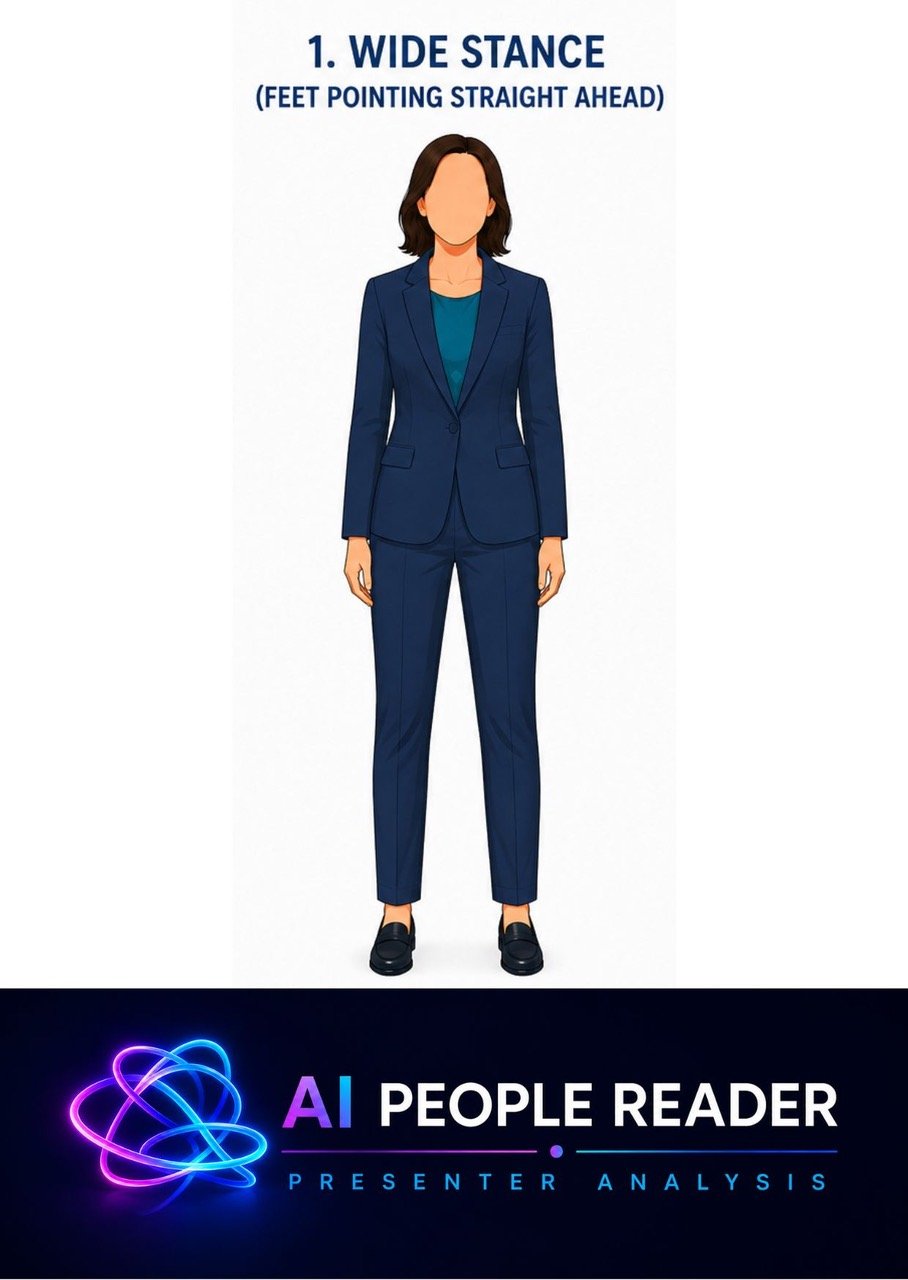
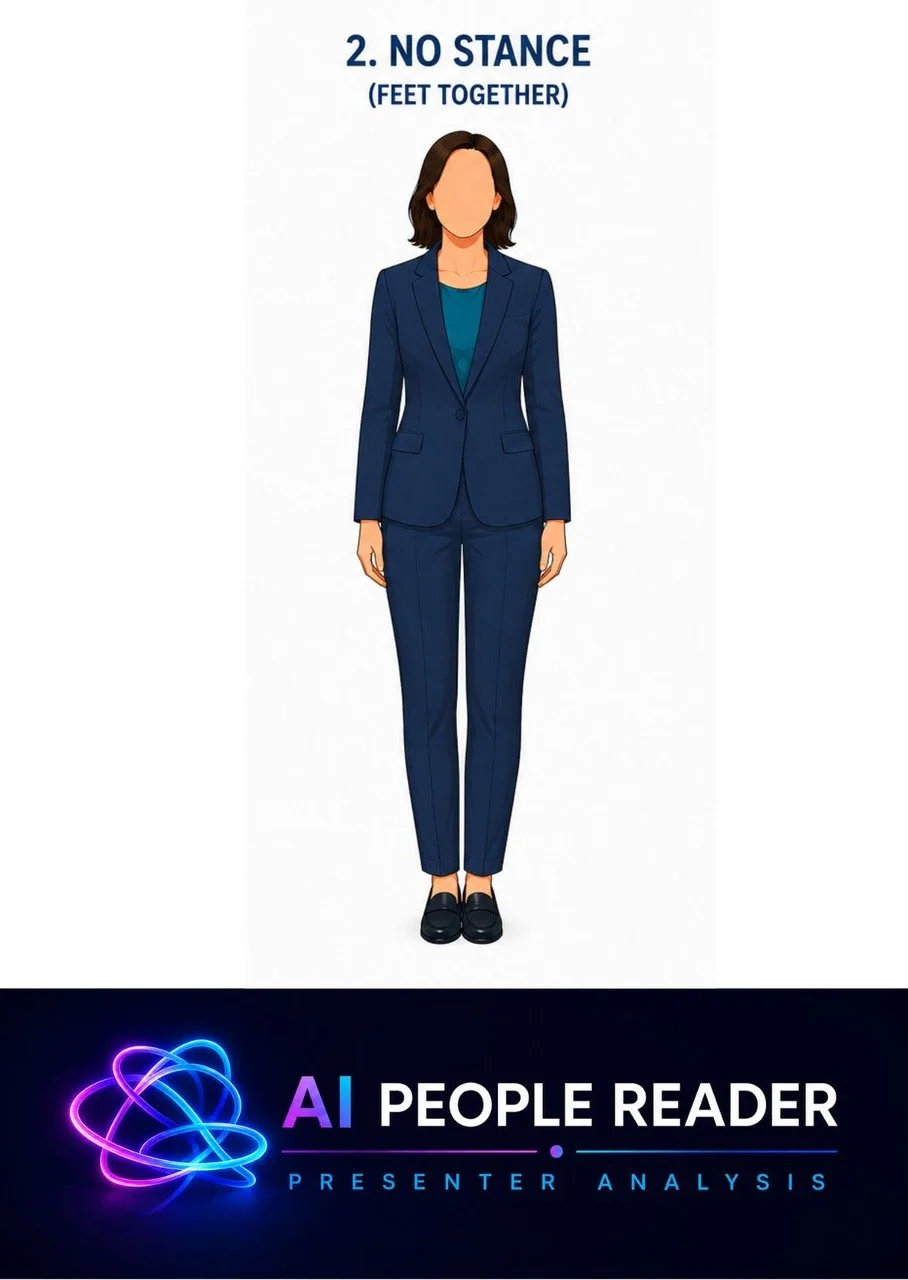
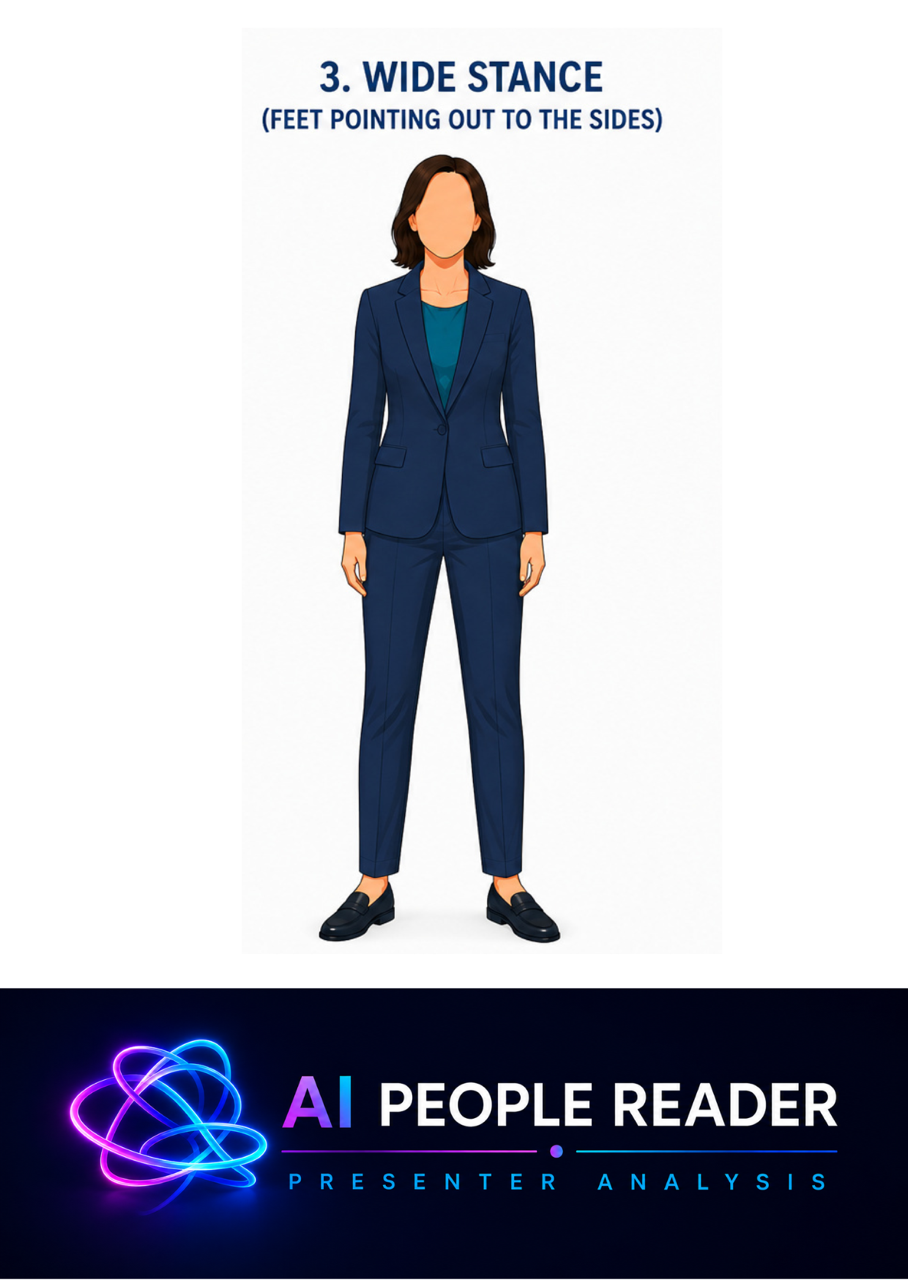
Before reading further, take a moment to look at the three illustrations.
What differences do you notice?
Which presenter appears more grounded? More confident? More contained? Does one appear more authoritative than another? And what do you notice about the direction in which the feet are pointing?
There isn't a single “correct” stance that everyone should adopt. What matters is understanding the movement pattern, the impression it may create and whether it supports what the presenter intends to communicate.
When having no stance is more than a physical habit
Over many years of working with CEOs, senior executives and teens, I have repeatedly noticed a relationship between habitual stance and the way people describe themselves and their relationship with others.
People who habitually stand with their feet together — what I refer to as having “no stance” — may also describe themselves as feeling small, insecure, overlooked or unappreciated.
I saw a striking example of this recently.
A young man in one of my classes was gentle and pleasant, but when he presented, he stood with his feet together and had very little physical base. As a result, his body appeared unstable and wobbly.
He had absolutely no idea he was doing it.
It was only when I showed him a recording of his presentation that he could see what I was seeing.
During his next presentation, he consciously tried to use a wider, firmer stance. He succeeded — for about 20 seconds. His feet then naturally returned to their familiar position.
Later, when he sat down, I noticed something else: his legs and feet were pressed together
His stance wasn't simply something he did while presenting. It appeared to be part of a much broader habitual way of organising herself.
Experiences like this are why I don't view stance simply as a presentation technique. Changing someone's stance may require more than telling them where to put their feet. A movement habit can be deeply familiar, and a new movement may initially feel completely unnatural.
What about a wide, firm stance?
At the other end of the spectrum, people with a wider, firmer stance often present with greater confidence and authority. In my experience, they may also be more inclined to stand their ground — and sometimes to push themselves forward.
I recognise this tendency in myself.
But again, this is not automatically good or bad.
If you are presenting an important proposal to investors, confidence, conviction and authority may be exactly what the situation requires.
The problem arises when one movement quality dominates regardless of the communication context.
I worked with a CEO who provides a good example. He was an engineer preparing for three very different communication situations: a media interview, an investor briefing and a town hall speech.
He was very nice, direct and forthright. However, members of his Thai team sometimes experienced him as slightly too aggressive.
When we reviewed his presentation video, his wide, firm stance was part of what we observed — but stance alone wasn't responsible for the impression.
His strong use of the vertical plane, combined with his firm stance, contributed to the overall movement pattern his observers were responding to.
We don't communicate in one dimension
In movement analysis, the vertical plane is strongly connected with presentation. It is in this plane that we stand up, establish ourselves, confront, defend and stand our ground.
There is a reason we normally stand when we formally present.
But humans are three-dimensional beings. We shape our movement around the three main spatial axes: horizontal, vertical and sagittal.
Relationships don't happen in only one plane.
Rather than trying to take authority away from this CEO, we worked on making his stance less confronting by transforming some of his fixed positioning into weight shifting.
By shifting his weight, he began introducing more movement in the horizontal plane — bringing a relational dimension into his movement — while continuing to communicate through his hand gestures.
He didn't need to become less confident or less authoritative.
He needed more movement possibilities.
This is an important distinction. Effective presentation movement isn't created by learning a collection of supposedly “good” gestures or poses. The feet, weight, torso, hands and use of space work together as an organised whole.
What direction are your feet pointing?
Width is only one aspect of stance.
The direction of the feet is also worth observing.
For some people, feet that point outward are simply habitual or related to the positioning of the hip joint, knees and legs. It would therefore be misleading to assign a particular psychological meaning to outward-pointing feet alone.
What I frequently encounter, however, are presenters who have no idea where their feet are pointing.
One foot may point forward while the other points noticeably to the side. When I show presenters the recording afterwards, they are often surprised.
This lack of movement awareness can become particularly noticeable when someone is extremely nervous. Attention is consumed by remembering the content, dealing with slides, facing the audience and simply trying to get through the presentation. Awareness of what the body is doing can disappear almost completely.
The issue isn't that the feet are pointing in the “wrong” direction. The issue is that the presenter has no self-awareness.
There is no perfect stance
I don't teach presenters to find one “correct” stance and remain there.
In fact, I encourage my students to alternate their stance.
Movement needs to change because communication objective changes.
There is, however, one point at which I believe establishing a stance is particularly important: the beginning of a presentation.
When you first stand in front of an audience, you are already communicating before you begin speaking. Starting with your feet together gives you very little physical base and can make the body appear smaller and less grounded. In some contexts, it can contribute to an impression of insecurity or even of being a pushover.
I therefore encourage presenters to begin with a shoulder-width stance.
Establish your base first. Then allow your movement to develop.
As the presentation progresses, you might narrow or widen your stance, shift your weight, move forward or reposition yourself according to what you are communicating and the relationship you are creating with your audience.
The objective is not to hold a “confident pose.”
It is to have a physical base from which purposeful movement can occur.
Awareness comes before change
The next time you watch a recording of yourself presenting, resist the temptation to look immediately at your face or hands.
Watch your feet.
Where do they settle?
Do they remain together? Do they spread? Does one foot point in a different direction? Do you repeatedly shift your weight? Are you firmly planted in one position?
And then look beyond the feet.
What is the rest of your body doing at the same time?
Your stance is not simply where you put your feet. It is where your movement begins — and it can tell us something about how you position yourself in relation to the people around you.
The goal isn't to learn the “correct” stance.
It is to become aware of your own movement patterns, understand how they may be perceived, and develop more movement possibilities so that your body can support what you intend to communicate.
See your presentation differently
You may know what you said. But do you know how you moved?
AI People Reader Presenter Analysis helps you see movement patterns that can be difficult to notice while you're presenting and understand how your movement may influence the way you're perceived.